


Introduction
One of the most common questions from homeowners is:
👉 “How many solar panels do I need for a 3-bedroom house?”
There’s no one-size answer. The correct number depends on:
- Your daily electricity usage (load)
- Type of appliances
- Battery capacity
- Available sunlight
This guide breaks it down using real Nigerian conditions, not theoretical assumptions.
Step 1: Understand Your Power Consumption
A typical 3-bedroom house in Nigeria runs:
- LED lights (8–15 points)
- 3–5 fans
- 1–2 TVs + decoder
- Refrigerator
- Laptops and phones
- Possibly a freezer or small pump
Estimated Daily Usage:
👉 3kWh – 7kWh per day
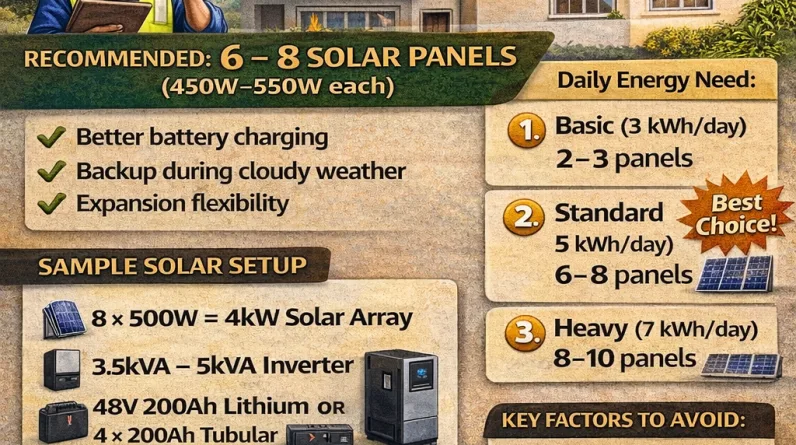
- Basic usage → ~3kWh
- Moderate usage → ~5kWh
- Heavy usage → ~7kWh+
Step 2: Know Solar Panel Output in Nigeria
Nigeria gets good sunlight:
- Average: 4–6 peak sun hours daily
A standard panel:
- 450W – 550W panel
- Produces about 1.8kWh – 2.5kWh per day (realistic output)
👉 This already includes system losses.
Step 3: Calculate Number of Panels Needed
Formula:
Number of Panels = Daily Energy Need ÷ Energy per Panel
Scenario 1: Basic Home (3kWh/day)
- Panel output: ~2kWh
- Panels needed:
👉 2 – 3 panels
Scenario 2: Standard Home (5kWh/day)
- Panels needed:
👉 3 – 5 panels
Scenario 3: Heavy Usage (7kWh/day)
- Panels needed:
👉 5 – 7 panels
Realistic Recommendation (Important)
In practice, don’t design at minimum.
👉 For a standard 3-bedroom house in Nigeria:
Recommended: 6 – 8 solar panels (450W–550W each)
This gives:
- Better battery charging
- Backup during cloudy weather
- System expansion flexibility
Example System Setup
For a typical 3-bedroom home:
- Panels: 8 × 500W = 4kW array
- Inverter: 3.5kVA – 5kVA
- Battery:
- 48V 100Ah lithium OR
- 4 × 200Ah tubular
👉 This setup comfortably powers essential household loads.
Factors That Affect Panel Quantity
1. Appliance Type
- Energy-saving appliances → fewer panels
- Old appliances → more panels
2. Battery Size
- Small battery = less storage
- Large battery = more usable power
3. Day vs Night Usage
- Heavy night use → more panels needed to recharge batteries
4. Roof Space
- Limited space may restrict panel installation
5. Budget
- More panels = higher upfront cost but better performance
Common Mistakes to Avoid
- Installing too few panels (very common in Nigeria)
- Ignoring system losses
- Not planning for future expansion
- Using fake or low-efficiency panels
Pro Installer Insight
From real field experience:
👉 Most system failures in Nigeria are due to undersized solar panels, not batteries.
If your panels are too small:
- Batteries won’t charge fully
- System will fail at night
- Inverter will start tripping
Cost Estimate (2026 Nigeria)
- 450W–550W panel: ₦120,000 – ₦220,000
- 6–8 panels:
👉 ₦720,000 – ₦1,760,000
Prices vary based on brand and market conditions.
Final Verdict
For a 3-bedroom house in Nigeria:
👉 Minimum: 4 panels
👉 Recommended: 6 – 8 panels
👉 Optimal (future-proof): 8 – 10 panels
Conclusion
The number of solar panels you need depends on your energy demand, not house size alone.
If you want:
- Stable power
- Longer battery life
- Reliable performance
👉 Always install slightly above your minimum requirement.
Need a Professional Load Calculation?
For accurate solar system sizing, installation, and consultation:












Worth marking this site as one to come back to deliberately rather than by accident, and a stop at tasseltract reinforced that intention, the difference between sites I find again by chance and sites I return to on purpose is meaningful and this one has clearly moved into the deliberate return category for me.
Thank you for keeping the writing honest and the points easy to verify against your own experience, and a stop at vesseltame reflected the same approach, no exaggeration just steady useful content that I can take with me into my own work without second guessing every sentence I happen to read here.