

Introduction
Before installing any solar system, load calculation is the foundation. If you get it wrong, everything else—battery size, inverter rating, and panel capacity—will be either oversized (waste of money) or undersized (system failure).
In Nigeria, where power supply is inconsistent, accurate load estimation ensures:
- Reliable backup during outages
- Optimal investment (no overspending)
- Longer battery and inverter lifespan
This guide breaks it down in a practical, field-ready method you can apply immediately.
Step 1: List All Electrical Appliances
Start by identifying everything you want to power with solar.
Typical Nigerian home appliances include:
- LED bulbs
- Fans
- TV
- Decoder
- Refrigerator
- Laptop
- Phone chargers
- CCTV system
- Water pump (if required)
Create a table like this:
| Appliance | Quantity | Power Rating (W) |
|---|---|---|
| LED Bulb | 6 | 10W |
| Ceiling Fan | 2 | 75W |
| TV | 1 | 120W |
| Decoder | 1 | 20W |
| Fridge | 1 | 150W |
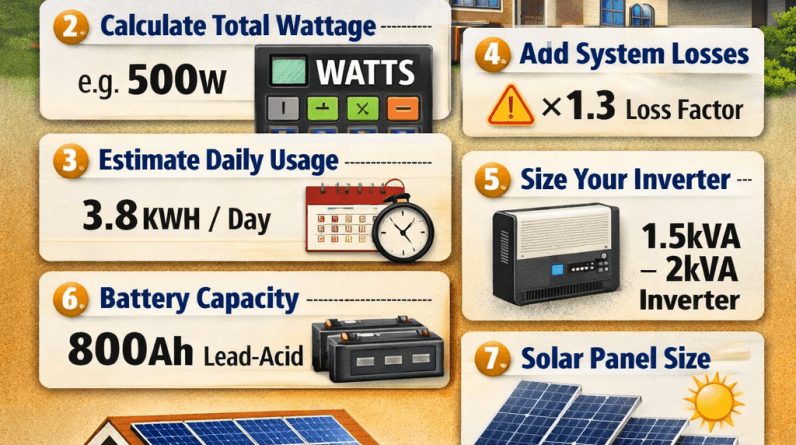
Step 2: Calculate Total Wattage (Running Load)
Multiply quantity by wattage:
Example:
- Bulbs: 6 × 10W = 60W
- Fans: 2 × 75W = 150W
- TV: 120W
- Decoder: 20W
- Fridge: 150W
Total Load = 500W
👉 This is your instantaneous load (what runs at the same time).
Step 3: Estimate Daily Energy Consumption (Wh)
Now calculate how long each appliance runs per day.
| Appliance | Power (W) | Hours/Day | Energy (Wh) |
|---|---|---|---|
| Bulbs | 60W | 6 hrs | 360Wh |
| Fans | 150W | 8 hrs | 1200Wh |
| TV | 120W | 5 hrs | 600Wh |
| Decoder | 20W | 5 hrs | 100Wh |
| Fridge | 150W | 10 hrs* | 1500Wh |
Total Daily Consumption = 3,760Wh (~3.8kWh)
*Fridge cycles ON/OFF, so we estimate reduced runtime.
Step 4: Add System Losses (Very Important)
In Nigeria, real-world losses are unavoidable:
- Inverter inefficiency
- Battery losses
- Heat (major factor in Port Harcourt)
- Cable losses
Add 25–30% buffer
Adjusted Load:
3,760Wh × 1.3 = 4,888Wh (~4.9kWh/day)
Step 5: Size the Inverter
Your inverter must handle peak load + surge load.
Rule:
- Minimum inverter = 1.5 × total load
Example:
500W × 1.5 = 750W → Use 1kVA inverter
But in practice:
- Go for 1.5kVA or 2kVA to allow expansion and handle fridge startup surge.
Step 6: Calculate Battery Capacity
Battery stores energy for night use or outages.
Formula:
Battery Capacity (Wh) = Daily Consumption × Backup Hours
Assume:
- 12 hours backup needed
4,888Wh ÷ 12V = 407Ah
Apply Depth of Discharge (DoD):
- Lead-acid: use only 50%
- Lithium: use 80–90%
Lead-acid example:
407Ah × 2 = ~800Ah battery bank
Practical setup:
- 4 × 12V 200Ah batteries
Lithium option:
- 1 × 48V 100Ah lithium battery (more efficient)
Step 7: Calculate Solar Panel Size
Panels must generate enough energy during sunlight hours.
Nigeria average sun hours:
- 4–6 hours daily
Formula:
Panel Size = Daily Energy ÷ Sun Hours
4,888Wh ÷ 5 hrs = ~978W
Add 20% margin:
👉 Recommended: 1.2kW – 1.5kW solar panels
Example:
- 3 × 450W panels = 1,350W
Step 8: Final System Summary (Example Setup)
For a small Nigerian home:
- Inverter: 1.5kVA – 2kVA
- Battery:
- Lead-acid: 4 × 200Ah
- OR Lithium: 48V 100Ah
- Solar Panels: 1.2kW – 1.5kW
- Charge Controller: 60A MPPT
Common Mistakes to Avoid
- Ignoring surge loads (fridge, pumping machine)
- Underestimating usage hours
- Not adding system losses
- Mixing heavy loads (iron, heater) with small systems
- Using fake or underrated inverter specs
Pro Tips (From Field Experience)
- Always separate essential loads from heavy loads
- Use LED appliances only
- Install proper earthing and surge protection
- In Port Harcourt humidity, prioritize lithium batteries for durability
- Leave room for future expansion
Conclusion
Load calculation is not guesswork—it’s a technical process that determines system performance.
If you:
- List appliances correctly
- Calculate wattage and usage accurately
- Factor in losses
…you’ll design a solar system that is efficient, scalable, and cost-effective.
Need a Professional Solar Design?
For detailed load analysis, system design, and installation:
Visit:
👉 www.honjekexpress.com
👉 www.honjektechnicallimited.com.ng